











What images come to mind when you picture Nashville? For tourists, it might be Broadway’s honky-tonks and their multi-colored neon signage. Maybe it’s the Batman Building’s spires rising over the skyline, or perhaps the arched ceiling of the Grand Ole Opry. These iconic locations are important for different reasons–they are social spaces, landmarks, and cultural centers. The buildings themselves contribute heavily to Nashville’s identity. But what would happen if they were to disappear?
The city has been growing rapidly since the 1990s. With that growth comes change–as well as conflict. The debate over “new Nashville” vs. “old Nashville” has been ongoing for almost three decades. Long-term residents sometimes claim that the city is losing its status as the “biggest small town” and that the influx of affluent people from out of state has worsened the cost-of-living crisis.
While most acknowledge that Nashville’s growth has been good for its economy and job market, it has also caused problems for residents. Issues like strain on infrastructure, price-hiking, and extreme gentrification all affect the city’s poorest neighborhoods most acutely. Nashville must dedicate resources to solving these side effects of development if it wants to grow sustainably.
There’s an equally important but lesser-known issue caused by this trend toward rapid urbanization, which, if not addressed soon, may be too late to solve: the preservation of Nashville’s historic buildings.
In 2019, the Nashville Report showed historic districts accounted for 20% of population growth between 2010-2016, and that property values in those areas significantly outperformed the rest of the city. Additionally, 40% of job growth occurred in historic districts, and heritage tourism supports nearly 20,000 jobs and $588 million in local revenue. These areas are also more walkable and have better access to public transit, parks, and schools. Clearly, preserving these districts immensely benefits the city.
Still, many of these sites are at risk. Music Row, for example, is central to Nashville’s identity as Music City. It’s known for the legendary studios and music labels housed in its turn-of-the-century bungalows, which are the quaint, nostalgic locations where many classic songs were first recorded.
As the music industry has grown, more of these houses are being subsumed into large buildings that match the corporate needs of music labels in today’s industry. That alone may be cause for caution about the way the street is protected, but increasingly, its properties are being sold to commercial developers, completely detached from the community at all. Gray, glass towers proudly display that they’re located on “Music Row!” while holding little connection to music or the community surrounding the row at all.
Historic Nashville Inc. is a nonprofit that has been fighting to preserve historic locations across the city for many years. They reported that after the loss of four major recording studios, an entire block of 19th Avenue can no longer be considered part of Music Row. Additionally, they wrote that Sound Shop on Division Street — where Paul McCartney and Wings recorded “Sally G” and “Junior’s Farm” — as well as Kelso Herston Enterprises on 16th Avenue and five buildings on Music Square West have been demolished to make way for apartment buildings.
It’s telling that even an area this important to Nashville’s identity (and significant for tourism) is losing so much of its history. It’s an example of a trend taking place across the city. As it continues, the areas affected are losing something extremely difficult to replace.
Old buildings are important for their connection to the past, and for the financial reasons listed above, but there’s another reason to advocate for their preservation: beauty. They often feature building techniques and materials that would be costly or impractical to implement today.
These historic buildings add irreplaceable charm and variety. They help lessen the monotony of modern “cookie-cutter” developments, which are optimized for efficiency and cost-effectiveness rather than aesthetics. Studies have shown that people are happier in more beautiful surroundings, regardless of whether those surroundings are natural or man-made.
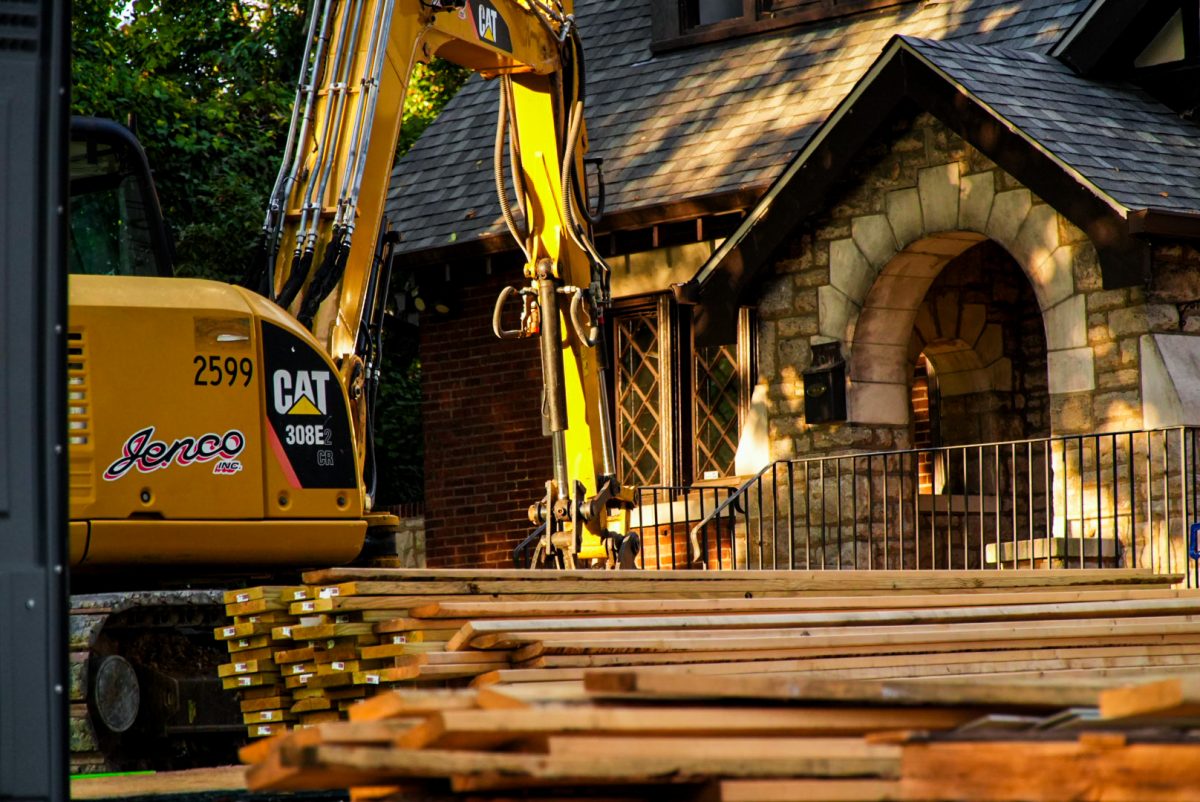
However, there is precedent to further development while still preserving the past. One of these initiatives is due to reopen completely this year after years of renovations: The Arcade. It was built in 1902 and was once a community hub. Stores and restaurants convened under its unique Palladian facades and gabled glass roof. But as the decades passed, foot traffic decreased, and many of its businesses were forced to close.
Since 2023, it has been undergoing a massive restoration. The architectural firm Dryden Studio has worked to rehabilitate the beloved building instead of demolishing it, and the result is finally being unveiled this year as its businesses reopen.
The Arcade’s central structure and unique embellishments have been preserved, while outdated mechanical and electric systems have been updated. Because of this method of repair, a space as charming as the Arcade will continue to be enjoyed by anyone on a trip downtown.
Nashville should not lose its historic neighborhoods to time, and the Arcade is one example of how to keep that architectural history intact. It can serve as a blueprint for how the city can continue to progress while ensuring that its vital character and beauty remain intact for future generations of Nashvillians to come.