






















Several years ago, when I was driving through downtown Nashville with my older sister, we passed by some giant soda straws at a roundabout. “I love public art,” my sister said, laughing, as I gawped out the window at the sculpture. “They’ll put anything up these days.”
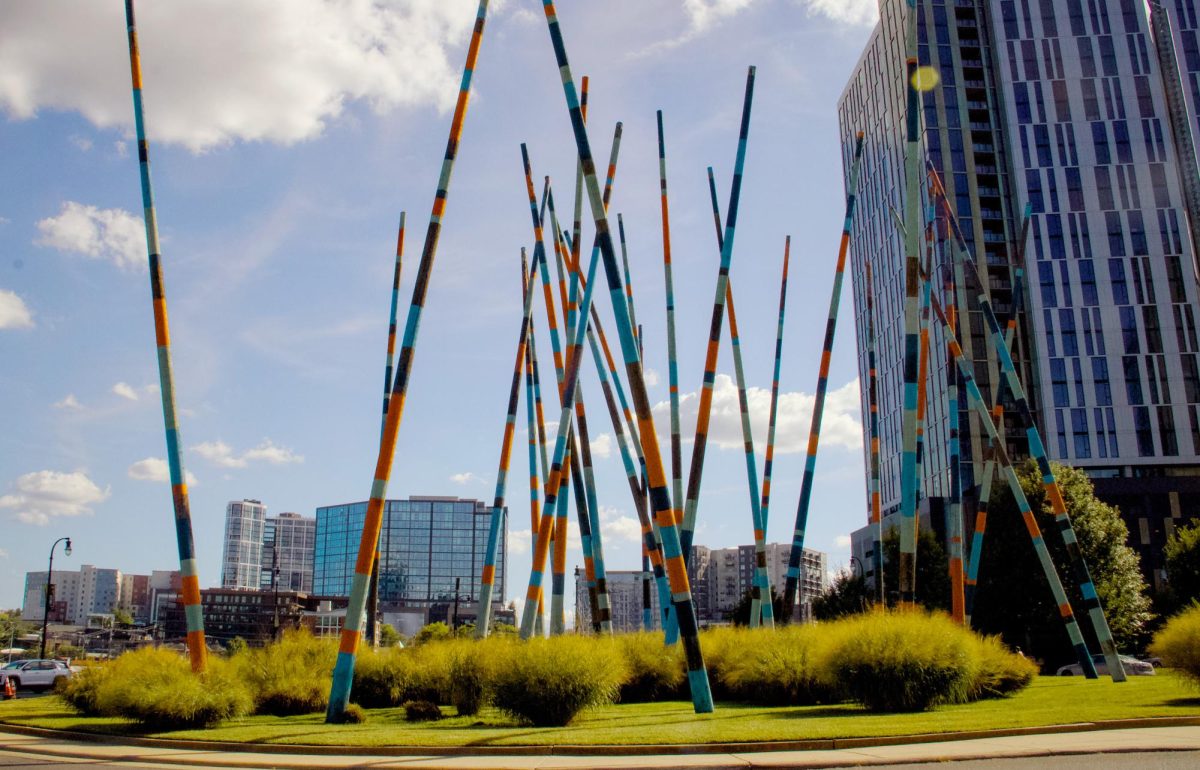
The sticks weren’t, as I had thought, straws but wooden poles — 70 feet tall and painted enthusiastically in orange and blue. Surrounded by the Gulch’s dense construction zones, the poles looked at first like a mistake, pieces of gaudy construction material that had been stuck at odd angles into the ground. But the columns instead constituted a work of art. The piece is called “Stix,” and it is now one of Nashville’s most recognizable public artworks.
At 13, I leaned toward the car window as we circled that roundabout, examining the poles with teenage ennui. I didn’t understand their purpose or like them much, but there is something about them that intrinsically draws the eye. “Stix” is confident in its weirdness. The cars circling the poles in the roundabout give the impression of an ever-twirling vortex, as if the sticks are inexplicably magnetic.
Eventually, these giant blue and orange beams become regular. After a few years, they were to me another weird but tested element that melded into Nashville’s metropolis. My eyes slid past when I saw them.
Was “Stix” built to stick out? Or was it intended to disappear quietly into the urban landscape? The piece cost $750,000 to build, making it Nashville’s most expensive public arts endeavor to date. The 27 poles required extensive underground supports drilled into Tennessee limestone: There is a deliberateness here. City officials and private investors have decided that “Stix” is the sculpture that Nashville should have.
Many Nashvillians believe “Stix” is an homage to indigenous settlements in Tennessee, after Christian Moeller, the designer of Stix, mentioned indigenous totem poles as an inspiration behind the structure. Moeller has maintained that he built “Stix” to honor the trees — unique to America — which have served as “wooden utility poles [supporting] our power and communication needs. These poles have come to represent a very iconic image of the American landscape,” Moeller said in an interview with the Tennessee Ledger.
Still, public art only has as much meaning as it is given by a casual viewing public. If you read Moeller’s interview, you might indeed view his poles as an homage to the trees that underlie American construction. But most people haven’t read up on Moeller’s intentions for the piece, so the artwork is left to whatever interpretation its audience assigns.
When I think of “Stix,” I think of when I first circled that roundabout as a child — how I was astonished to find giant soda straws invading this patch of urban landscape. “Stix” makes me think, foremost, of the absurdity of our exponentially growing city. New, bizarre, life-giving growth appears every day in Nashville; they startle us, anger us, attract us. Yet even giant sticks will, over time, assimilate into our city’s constantly evolving landscape: They will meld into Nashville. Eventually, they will become our city — and I embrace them.