



























Representing most of Washington County and its 140,000 constituents, Rebecca Alexander started out her career writing instruction manuals. Yes, household appliance instruction manuals! Out of college, Alexander worked for the consumer electronics company, Philips, writing up descriptions on how to assemble anything from coffee machines to electric toothbrushes to large-scale medical equipment. In a matter of years, Alexander worked her way up from the copy desk to the team of top national sales representatives in a Fortune 500 company. This was an achievement by itself, but what makes the story more interesting is that Alexander was the only woman among 300 sales agents at Phillips selling some of the top domestic products worldwide.
Collaborating and competing with a team of 299 men was Representative Alexander’s training ground. She quickly learned how to both compromise and develop her own voice, to be an individual and a team-player. This training allowed her to gain the confidence and skills to eventually participate as a moderate in a male-dominated legislative environment with a Republican supermajority.
It is no secret that the Tennessee state legislature is seen as a kind of battlefield, drawing criticism from local and national press about the partisan fights surrounding issues from school vouchers to gun laws. As a student reporter, I was naturally intimidated to interview a Republican working in this combative space.
But when I jumped on a call with Alexander, her warm tone put me at ease. I began to listen with an open mind to an elected official who sees herself blending traditional values with a forward-looking concern for youth and education. I heard her express both her pride as a Republican and her willingness to stand apart from the pack.
Rebecca Alexander grew up on a dairy farm with her parents and sisters, before attending Milligan College where she majored in English and education based on a love for writing. She was hired by Philips as an editor, and worked her way up to national sales where she worked for 11 years. Alexander then moved back to East Tennessee to raise her two daughters and help run her husband’s business. After earning a masters in storytelling at East Tennessee State University, Alexander began performing biblical stories as a keynote speaker at churches in her area.
Rep. Alexander had no background in politics when she got a phone call asking her to run for office – and initially, she laughed off the thought. With more consideration, she realized how her experience in both agriculture and corporate business could help her define a political role.
She now represents the East Tennessee district population where she lives. While in session from January to April, she drives to Nashville on Sunday nights and stays until Thursday. On a typical Monday, Alexander begins committee meetings around 8:00am. From that moment on she divides her time between the various committees she serves on–agriculture, judiciary, transportation, and child and family services–, meetings with lobbyists, and 1 to 5 hour sessions on the house floor debating bills, until it’s time for her to return to her district. Back home she talks to constituents, and tries to understand their most pressing concerns. The greatest challenge Alexander faces, she says, is that she’s “a people-pleaser, and you cannot easily be a people-pleaser as a legislator where you have to represent the entire district.”
Alexander also spoke to the political polarization in this moment, especially with a Republican supermajority within the Tennessee legislature. As a moderate Republican, she aims to work across the aisle and feels that “more than anything we have to be open to listen and talk to each other, to put our ideologies aside and focus on what is the best for our state.”
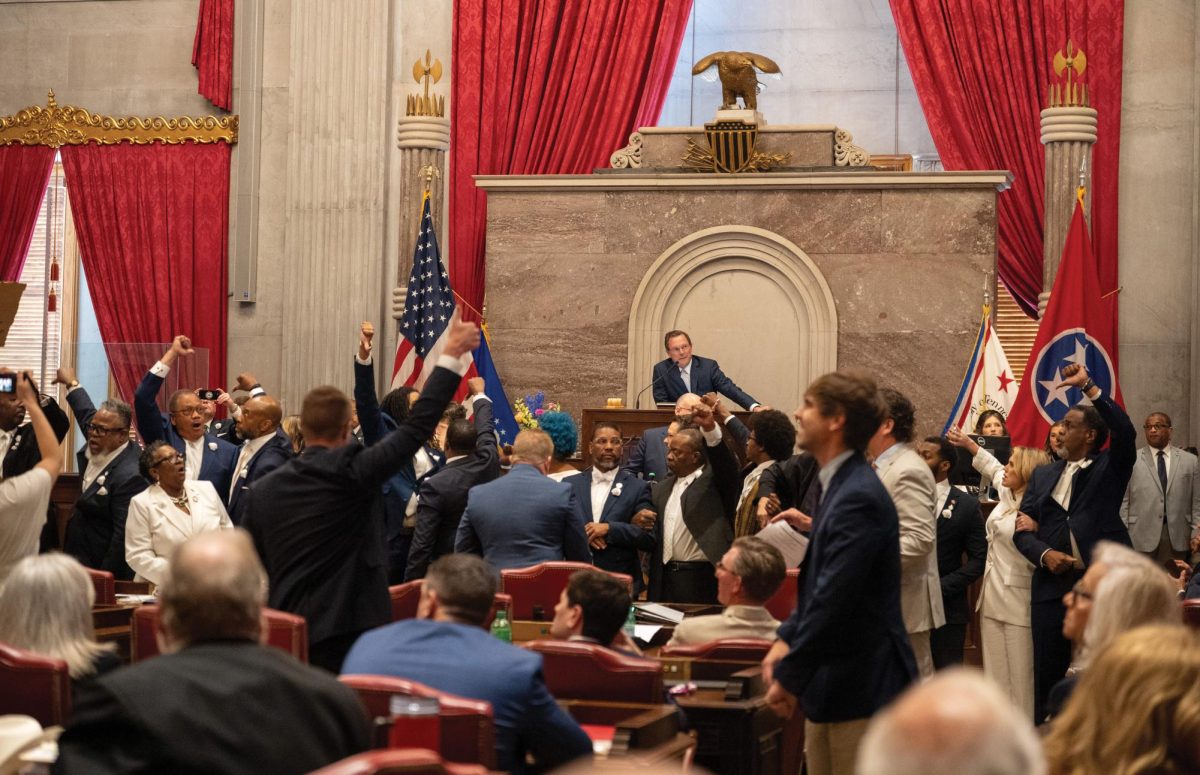
She emphasized her belief in “decorum across party lines,” bringing up the 2023 expulsions of three Democrats from the state legislature as an example. This was a controversy that attracted a national spotlight, as the power to expel members is typically reserved for cases of serious misconduct. A number of Democrats, including former Presidents Joe Biden and Barack Obama, viewed the removals as undemocratic and even authoritarian. Alexander framed the issue as a matter of etiquette, with Democrats being “too vocal on the House floor.”
Rep. Alexander has a history of voting with her party on major issues including gun laws and abortion, but she has also co-sponsored bipartisan bills on phone bans in schools, protecting kids from harmful media, supporting positive male role models, providing free school breakfast and lunch to disadvantaged students, and other issues. Recently, Alexander has been addressing the impact of the government shutdown on food insecurity for 800,000 Tennesseans who rely on SNAP coverage, and sharing food bank locations in her community on her Facebook page.
In our conversation, Rep. Alexander emphasized the importance of a female perspective within the general assembly: “Women do tend to bring a tender perspective to things that men sometimes brush over in their literal thinking…We need mens’ grounded and good common sense, too, it’s all about a balance.” With prior experience working in a male-dominated industry, Alexander gained insight that has helped her to build support from male representatives and lobbyists for female-centered laws.
An example was her work to pass the STEP therapy bill for metastatic cancer (HB 0858). The STEP bill allowed oncologists to prescribe a stronger drug for metastatic stage 4 cancer, instead of the weaker drug that insurance was providing. Representative Alexander introduced this bill alongside Republican Senator Bo Watson, not thinking it would pass and having to constantly fight insurance lobbyists. Alexander used her own experiences with breast cancer to emphasize the bill’s importance to other members of the general assembly, and worked with Democrats for the bill to eventually pass unanimously.
Alexander also introduced the cell phone bill (HB 0932) requiring Tennessee school districts to adopt policies prohibiting student cell phone use during instructional time. The bill faced initial pushback from parents with concerns that it would prevent emergency contact and that cell phone use should be regulated by a child’s family rather than the General Assembly. Moreover, some Democratic lawmakers raised concerns about the broad scope of the ban. However, Alexander worked to convince them that the bill’s general intent to reduce distractions and counteract declining mental health due to social media outweighed the cons. Alexander says the positive effects of this bill are already evident, with more classroom engagement, higher grades, less bullying, and overall promotion of human connection in Tennessee schools.
With regard to Gen Z in politics, Alexander expressed concern about teens becoming radical in their partisan affiliation, and worries that acts like protesting decrease productivity, deepen divisions, and discourage open dialogue. She was hopeful about the trend on college campuses allowing civil discourse to spark.
Finally, Rep. Alexander expressed the importance of younger generations getting involved with civic life through organizations on college campuses and local engagement to understand how systems work. She encourages young students like myself to sit in on a local civics meeting or talk with town leaders, saying, “we can’t fight issues that might be in Texas or California, but we can learn and help one step at a time in our own areas.” She encourages students to seek common ground, explore differing perspectives, and agree to disagree.