











In the wake of conservative activist Charlie Kirk’s Sept. 10, 2025 assassination, Americans’ ability to access our elected officials may be permanently changed.
Town halls gained popularity in the United States in the 20th century as a way for ordinary citizens to be able to speak directly with their elected officials. They have ties to the town meetings that once took place in the New England colonies, where communities would discuss and vote on issues in churches and taverns. One of these meetings, where a crowd discussed the tea crisis, eventually led to the Boston Tea Party.
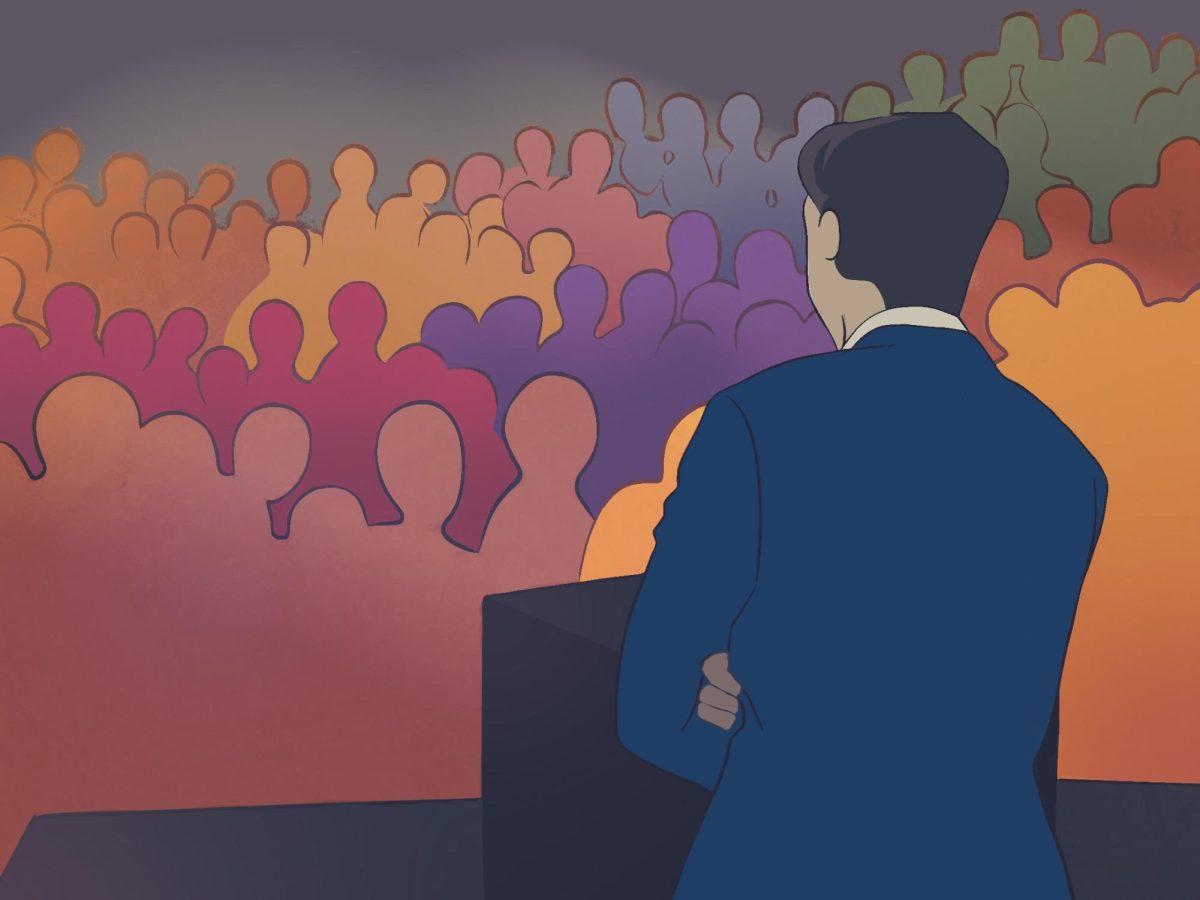
In the modern era, what we think of as town halls — elected officials responding to questions from the public — have become a staple of our democracy. Other forms of communication make it hard to ever actually speak with a representative. Sending an email, calling, or even interacting on social media are all common methods used to contact politicians, but they usually result in reaching a staff member, if anyone at all.
The ability to talk to a representative directly is an important part of a healthy democracy. It allows constituents to express their concerns and question our elected officials in an unscripted environment. The representatives leave with a better understanding of what issues their constituents care about, and the constituents leave with an unfiltered view of our elected officials and the feeling that we are being listened to by the people in power, which strengthens political efficacy. It’s an opportunity for both parties to interact on a personal level with one another.
While some of these discussions may turn emotional, lawmakers need to deal with their discomfort. They must recognize that nonviolent, passionate people showing up to advocate for a cause should speak to that issue’s importance, rather than being used as an excuse for a legislator to ignore it.
Local elected officials who have experienced hostility are more likely to worry about future hostility. The more they worry, the less likely they are to run for reelection, work on controversial topics or participate in public events, according to the Bridging Divides Institute at Princeton University. Furthermore, a report from the Brennan Center for Justice, a democracy nonprofit at New York University School of Law, found that half of officeholders were reluctant to communicate via social media because of abuse, and 23% of officeholders were less likely to hold events in public spaces for the same reason.
Following Kirk’s murder, legislators across the nation are refusing to appear publicly out of fear of political violence. Democratic Rep. Alexandria Ocasio-Cortez of New York’s 14th Congressional District has canceled two public events, including a rally, per NBC News. Shortly before this, she had gone on a “Fighting Oligarchy” tour with Sen. Bernie Sanders, an Independent from Vermont. Republican Nancy Mace, a gubernatorial candidate in South Carolina, is canceling all outdoor and public events for the foreseeable future and has stated that she will start carrying a firearm. The number of representatives taking these steps will surely grow.
There have been more assassination attempts and assassinations of high-profile political figures in the last 14 months than at any other point in U.S. history since 1968, the year both Rev. Martin Luther King Jr. and Robert F. Kennedy were killed, according to Axios. Political violence has risen in recent months, particularly during the election cycle, where many election workers were threatened, intimidated, and doxed, per a PBS News analysis.
PBS also reports that right-wing extremist violence has been responsible for the vast majority of U.S. domestic terrorism deaths since 2001, causing 75% to 80% of deaths, compared to 10% to 15% of incidents and 5% of deaths caused by left-wing extremists, which include anarchists and environmental groups.
Republicans are worried about what they see as a rise in violence against the right. Democrats fear that those on the right who blame the left for Kirk’s murder will go after Democratic lawmakers as retribution. Two Democratic lawmakers in Minnesota were assassinated in June 2025, and Kirk’s assassination serves as additional justification for legislators across the political spectrum to claim that public appearances may no longer be safe.
The last clause of the First Amendment to the U.S. Constitution states, “Congress shall make no law (…) [abridging the right of the people] to petition the Government for a redress of grievances.”
In other words, we have the right to tell our elected officials exactly how good a job we think they’re doing. They can’t stop us. What they can do, however, is limit our ability to access them.
Sure, it is justified for elected officials to take precautions in this era of targeted violence. It is also essential that they find ways to continue engaging with the people they are supposed to be representing. Currently, most are moving to small or online events that are only accessible to their base. This cannot be the future of constituent engagement. Recent tragedies should not be used as a way for lawmakers to avoid or ignore the people they are supposed to be serving, especially the ones they disagree with.
At this point, it’s unclear what modern town halls might look like. Perhaps they emerge as Zoom meetings, live streams or other technologies of the digital age. However they take shape, it is essential they preserve the core of what town halls are meant to be: question and answer sessions where ordinary citizens get to talk directly to their representatives in an unscripted, honest environment.
Elected officials’ jobs are to serve the people of their home district or state, not a political party, and not a political figure. If they want to fulfill that duty, then they must hold truly public, open events, even if they are now virtual. They cannot listen only to the people they know who already agree with them. They must hear all of the voices they are supposed to be representing.
Political polarization has contributed to recent violence. Our only hope of coming back together as a country and repairing our wounds is fighting back against division, rather than a group of people. One way to do that is to continue to create space for civil discourse and productive environments where Americans across the political spectrum can come together and work to solve the issues facing our nation.