




















As winter gives way to spring, a host of political candidates are revving up their campaigns for the midterm elections. These races for positions in local, state and federal government take place halfway through the four-year presidential term and create an opportunity for new candidates to break onto the political scene.
The elections begin with a critical part of the democratic process that is often overlooked: the primaries.
Primary races select the leading candidates that will represent each party in the general election. This is an opportunity for newcomers to get noticed, even if they don’t win. Paying attention to these races is a way to understand where the political parties are right now, and where they could be headed in the future.
On Aug. 6, 2026, Tennesseans will vote for party nominees for offices like governor, U.S. Senate, U.S. House, state senators and state representatives. Candidates have until March 10, 2026 to qualify for the ballot, and several key races are already drawing attention.
Among them are contests for U.S. Representative for Tennessee’s 5th and 7th Congressional Districts, as well as the races for a seat in the U.S. Senate and the governorship.
The race to control Tennessee’s 5th Congressional District, which includes Columbia and some of Nashville’s southern suburbs like Brentwood, is expected to be particularly competitive. Candidates on the Democratic side include a Nashville Metro councilmember, Columbia’s mayor, an adjunct professor, and a healthcare executive. On the Republican side, incumbent Representative Andy Ogles faces the former Tennessee Agriculture Commissioner.
In the battle for governor, voters in the Republican primary can get ready for a Congressional showdown as U.S. Representative John Rose, who currently represents Tennessee’s 6th Congressional District, runs against U.S. Senator Marsha Blackburn. On the Democratic side, five candidates — including former 2022 candidate Carnita Atwater as well as a Memphis City councilor, a business owner and a musician — are vying for their place on the ballot.
Rose is an underdog candidate for the governor’s race. He has represented Tennessee’s 6th Congressional District since 2018, serving areas including eastern and southern Davidson County and extending into other parts of Middle Tennessee. An eighth-generation Tennessean who grew up in the 6th District, Rose previously worked as a farmer and owner of an agricultural tech business.
Most polls show Blackburn with a huge lead. The Beacon Center notes that Blackburn is far more widely recognized, has support from the majority of Republican voters and is a key ally of President Donald Trump.
Still, the primary is months away and is early in the process. One Laurence County straw poll showed Rose beating Blackburn 60.8% to 35.2%, suggesting that enthusiasm at the grassroots level could affect the election.
If polls get tighter as election day approaches, victory could be dependent on turnout at the primary.
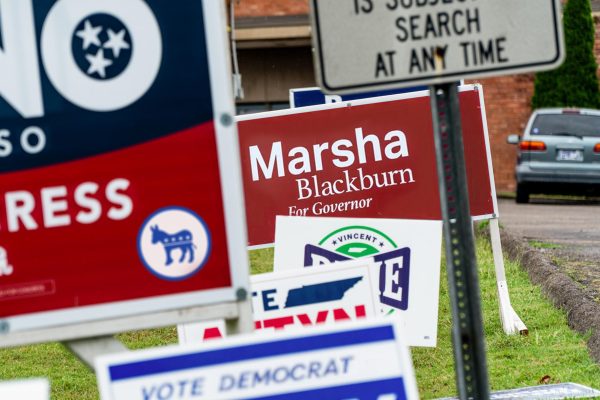
In August 2024, the Tennessean reported that only 13.9% of registered Tennessee voters participated in the state primary, including early, absentee, and election day voting. This is the first time the percentage has dipped below 14% in decades, and the state’s August primary turnout has been below 15% only three times in the past 30 years.
Chloe Akers, founder of The Best of Tennessee, a nonpartisan Nashville-based group committed to increasing voter engagement in primaries, called the numbers troubling.
“That’s extraordinarily low,” Akers said. “We are always in about the bottom 10% of states for voter turnout at the primary and the general.”
In 2022, Tennessee ranked last in voter turnout among all U.S. states. While the number of registered voters in the state has increased in the past decade — from 3.9 million in 2016 to 4.6 million today — fewer voters are actually participating in elections. And even though registering to vote is easier than ever, with online registration now available, only 80% of eligible Tennesseans have registered.
By determining which candidate a political party endorses, primaries shape how that party is perceived and which priorities it supports. Furthermore, primaries are an important step in determining which political party will control Congress.
In addition, a low voter turnout can also mean that a relatively small group of partisan voters repeatedly selects candidates who reflect their views, while others stay home, believing their vote won’t matter.
And for voters wondering why their party only endorses one candidate — and often one that’s very far on one end of the spectrum or the other — the answer often lies in the primary.
“Traditionally, people who tend to vote in primaries… tend to be more hyperpartisan and more ideologically extreme on both sides,” Akers said.
All of this means that primaries have a massive impact on the U.S., despite the fact that only 13.9% of Tennesseans decide to take advantage of them.
When outcomes are decided by such narrow margins, each vote – your vote – becomes more influential – even more so than in a presidential race.
“Republican primaries in Tennessee in 2024 were decided by an average of 1,054 votes. So when you vote in a primary, your vote is very powerful,” Akers said.
When asked for her advice for students, Akers said, “It’s critical to read and listen and absorb how [an] event is described by different media sources and to empower yourself with information at every turn, so that when you are eligible to vote, you are participating as an informed citizen.”
The more voters dive into civic participation, the more they can start to change the rhetoric that one vote doesn’t matter and start viewing voting as a way of supporting democracy, feeling patriotic, and fulfilling their duties as citizens of the United States of America.