
























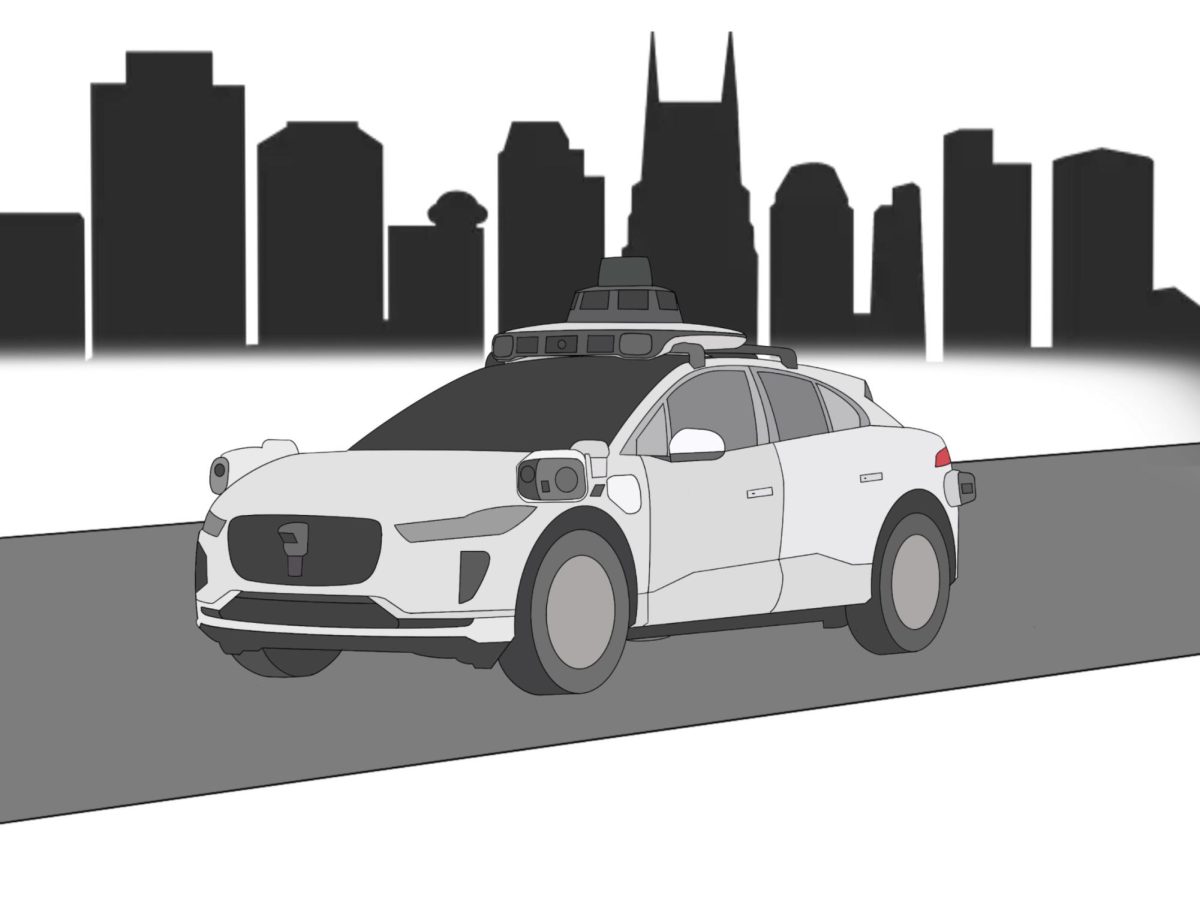
Driving the streets of Nashville, you may have seen funky white cars with giant cameras and sensors whirring on their roofs and hoods. It’s spooky but also exciting, especially if you see one without someone in the driver’s seat. These bot-cars cruising around Nashville – the seventh city in the US to adopt this new form of transit — are Waymos, also known as self-driving cars, robotaxis, or AVs (autonomous vehicles). The company behind this growing trend, Waymo, operates the world’s first and largest AV service, recently crossing 450,000 paid rides per week and surpassing 127 million miles driven without a human safety driver on public roads.
Boasting that their robocars are much safer than human drivers, Waymo states that their vehicles cause “90% fewer serious injury crashes, 81% fewer injury-causing crashes,” and even “92% fewer pedestrian crashes with injuries” compared to the “average human driver.”
Those are impressive numbers, but is Waymo as safe as they claim? How did they get here, exactly? What are the benefits to the early-adopter cities, and what are the risks?
Waymo already has 2,500 vehicles operating in six cities: Phoenix, San Francisco, Los Angeles, Miami, Atlanta, and Austin. Waymo recently announced it will officially roll out its AV service in Nashville this year, and already, some of these vehicles no longer have human drivers. Until recently, the Waymos around Nashville were just conducting “mapping” runs, typically with a human behind the wheel to ensure safety and help them learn the unique challenges of our city, such as the chaotic pedestrian traffic on Lower Broadway and the frequent construction zones.
Because of Tennessee’s “autonomous-friendly” regulations and Nashville’s rapid population growth, the city was chosen as a key location for expansion. An example of this is the Senate Bill 2253 (2025), which solves a major legal headache by establishing clear protocols for police to issue citations directly to the vehicle’s corporate owner, rather than leaving officers guessing who to ticket when a driverless car commits an infraction.
Local officials have supported the expansion, hoping to address our notorious traffic and safety challenges. Governor Bill Lee offered his support, saying, “As families and businesses move to Tennessee in record numbers, our state continues to lead the nation in finding innovative solutions to transportation challenges. By leveraging private sector technologies like Waymo’s fully autonomous vehicles, we’re exploring possibilities we couldn’t achieve on our own.”
The data on the safety of Waymo’s has raised some questions. Critics have pointed out that, since Waymos primarily operate on urban surface streets with speed limits of 35–45 mph, it would be misleading to compare this to “average human driving,” which includes high-speed highway travel, rural roads, and extreme weather, where the vast majority of human casualties occur. Critics have also pointed out that while Waymo releases summary reports, it does not release the raw data, making it difficult for outside researchers to fully verify its claims.
We have miles to go before Waymo is a widely trusted brand in Nashville, but there’s an interesting backstory that goes back to 2009, when Google launched the “Google Self-Driving Car Project” within the Google X lab, Google’s secretive research and development facility dedicated to inventions. The team running this project was led by Sebastian Thrun and Anthony Levandowski. The turning point came in October 2015, when Steve Mahan, who is legally blind, took the world’s first fully autonomous ride on public roads with no human backup driver.
Graduating from Google X in December 2016, the project became what we now know as Waymo, a standalone company under Google. Later, in 2018, Waymo One was rolled out in Phoenix in partnership with Lyft, becoming the world’s first commercial AV service, but it still had human safety drivers. It wasn’t until 2019 that Waymo launched its service to the general public without a human safety driver. Fast forward to today, Waymo has partnered with major ride-hailing service apps, allowing users in cities like Austin and Atlanta to hail a Waymo through Uber or Lyft in Phoenix.
The presence of robotaxis in our city raises the question of job costs. We can’t deny that Waymo will take business from taxi drivers and those who depend on ride-sharing apps as their main source of income. A Nashville resident, Montique McLain, who has driven for Uber and Lyft for nine years, recently had her pay decreased without explanation. McClain told the Nashville Scene that Waymo is “a way to phase (human drivers) out.”
According to Gridwise, driver pay in cities where Waymo operates, such as Austin, Los Angeles, Phoenix, and San Francisco, decreased on average by 5.3% between July 2024 and July 2025 in the number of trips per hour. Specifically in San Francisco, median hourly wages declined by 1.7%. While Waymo won’t fully replace these ride-share drivers any time soon, it will likely further affect their earnings in Nashville as it launches.
We also need to consider what Waymo’s presence in Nashville means for the people, especially teens. Assuming Waymo’s claims about their safety are true, the presence of driverless taxis could be valuable to students and parents who question whether it’s safe for teens to use Uber and Lyft, especially given increasing concerns about the assault record of Uber drivers. This could make life much easier for students who can’t drive, don’t have a ride to where they need to go, and can afford to take a Lyft. Parents would gain peace of mind, too, letting their children catch a ride without worrying about who is behind the wheel.
It’s not a simple net gain or loss: while students who can afford them might greatly benefit from AVs, taxi and ride-share drivers will suffer lower wages. Whether it is positively or negatively, these AVs could be changing Nashville sooner than you think.