


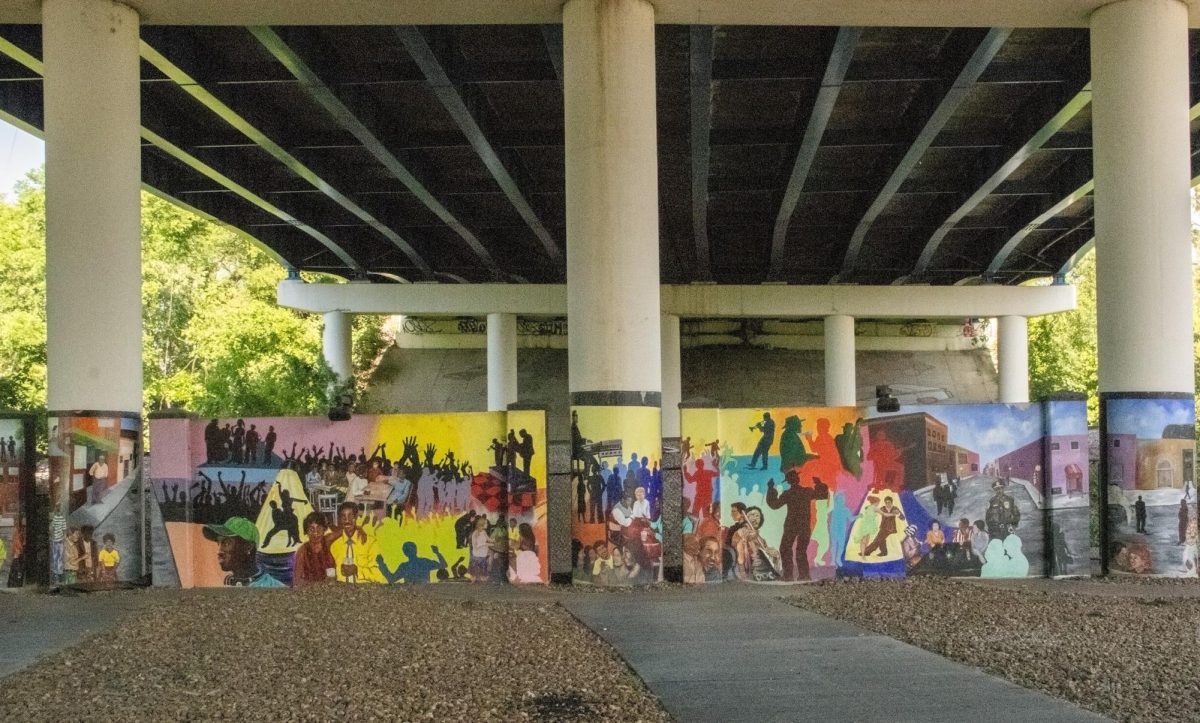






In 2012, something startling happened on the plaza under the I-40 overpass in North Nashville. Overnight, a stretch of blank wall on the plaza’s west side suddenly transformed into an enormous, vibrant mural, featuring a medley of local characters and scenes: dancers, musicians, and students; ballrooms, businesses, and colleges.
“You walk by this area, and one day it’s a blank wall space, and then the next day, after we installed it, you have a full mural,” said artist James Threalkill of the mural’s installation over a decade ago. Threalkill created the mural with fellow local artist Michael McBride. The pair painted their design on polytab cloth in their studio before transferring it to the plaza wall. For locals, the finished mural simply appeared out of nowhere. “Just the amazement of something like that happening,” said Threalkill, “that was fun to see.”
The Gateway to Heritage Mural — or the Jefferson Street Mural, as it’s often called — resonated immediately with its North Nashville audience, who recognized it as a tribute to the historically Black neighborhood’s vibrant history. Nearby historically-Black colleges and universities (HBCUs) including Fisk University, Tennessee State University, and Meharry Medical College feature on the mural. So do old Jefferson Street businesses, including the Ritz Theater and the Jefferson Street United Merchants Partnership, a local nonprofit.
The mural reflects Jefferson’s Street’s “Golden Age” in the mid-20th century, a period during which the historically Black neighborhood boasted a thriving music scene. The district was one of America’s best-known developers of jazz and blues. Musicians like Duke Ellington, Jimi Hendrix and Ray Charles frequented its clubs. The neighborhood also hosted prominent HBCUs and booming local businesses.
In the late 1960s, Nashville authorized the construction of Interstate 40, which cut through the heart of Jefferson Street. Houses were ripped up, residents were forced to move, and local businesses suffered. Many, including the Ritz Theater, closed.
“They just wiped out everything,” longtime Jefferson Street resident Nathaniel Harris said of the interstate’s construction. “The whole community looked like they just dropped a bomb.”
Nashville’s decision to construct an interstate through a Black neighborhood was not anomalous on the national stage — Black communities in cities such as Atlanta, Miami and Birmingham faced similar perils after local governments chose to tear through their neighborhoods following the adoption of 1956’s Federal Highway Act. In the 1960s, interstate planning created its own form of racial discrimination.
Despite decades of economic hardship after the construction of the interstate, Jefferson Street residents organized to revitalize their neighborhood. Locals opened new businesses and developed initiatives to boost the arts in the area again. Resident Carlton Wilkinson opened an art exhibition center, In The Gallery, to support up-and-coming local artists. Initiatives like these empowered North Nashville artists, including Threalkill. Through spaces like Wilkinson’s gallery, Threalkill said, Jefferson Street artists were able to “organize into a more cohesive voice advocating for resources in that part of town.”
Still, the impact of I-40 loomed over the neighborhood. Jefferson Street remained derelict where the highway cut across it.
“That was such a rundown area of North Nashville,” said Threalkill of the interstate overpass. “Homeless people were trying to take shelter [there] and trash was thrown over the area.”
So a local organization had an idea: to create a mural in the overpass, which would beautify the area while acknowledging the harm that the interstate had caused to the Jefferson Street community. Threalkill and McBride, who had been working on murals together since the 1980s, were approached for the job. The Gateway to Heritage Mural was the result.
To represent details of Jefferson Street’s Golden Age, Threalkill drew from memories of his own childhood in the area. “The Ritz Theater is a theater that my mom took me to when I was a preteen to go see movies,” he said. The theater features prominently on the left-hand side of the mural.
Threalkill also hosted discussions with community members to get their input on what the mural should include. And he incorporated some iconic symbols of North Nashville: Jimi Hendrix, for example, who frequented Jefferson Street clubs, and Fisk Jubilee Hall, which housed the famous Jubilee Singers.
“When people talk about North Nashville, those are typically the kinds of things that they talk about,” said Threalkill.
But it was important to include modern details in the mural, too. Threalkill said he sought to create images that would make young people feel “not only represented, but connected to the significant history of the area.” By a scene of an old Jefferson Street nightclub, for instance, he painted a young man wearing headphones. The next generation, too, is a part of Jefferson Street’s legacy. The mural celebrates the neighborhood’s future as well as its past.
In the years following the Gateway to Heritage mural’s sudden appearance under the I-40 overpass in 2012, the Jefferson Street community has embraced the mural as a testament to Jefferson Street’s history as well as its resilience. “People, as years progressed, just talked about having gone over to the mural and commented on how it made them feel, how it made them reminisce,” said Threalkill. “That let us know that we had achieved our goal of trying to celebrate the vibrancy of North Nashville in a way that hadn’t been done before.”