






As the school year draws to an end, many of us are shifting into jobs, internships, camps and hopefully some much-needed downtime. One of the best parts of the break from daily school and homework — apart from pool days, popsicles, and Netflix binges — is finally getting to read the books you want to read, not just those you’re assigned in school.
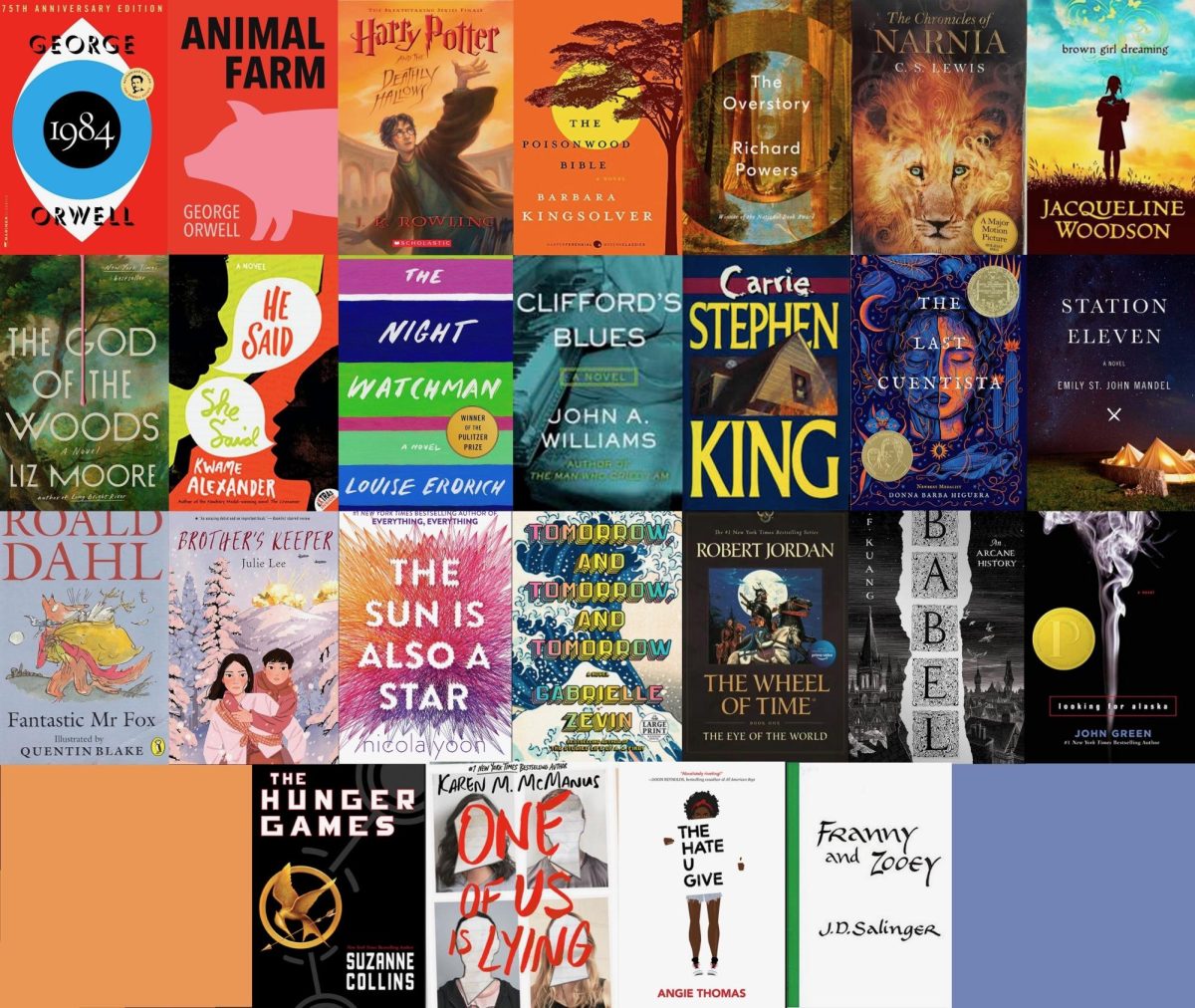
To help you build out your pleasure-reading list, we asked 25 Nashville SUNN contributors to recommend their faves. Here are the results! They range from old classics to light novels to fantasy and verse — we hope there’s something for everyone on this list. No matter the genre or publication date, all of these stories have something to teach us that we can apply to our lives here and now as students in 2026.
“1984” — George Orwell (1949)
Genre: Dystopian fiction
Quick rundown: A classic dystopian novel about a totalitarian regime that uses mass surveillance, media censorship, and psychological manipulation to control its people.
Why it matters for us, today: Its core themes of mass-surveillance and media manipulation are relevant to our lives in the digital age, and serve as a cautionary tale not to believe everything we see on social media.
“Animal Farm” — George Orwell (1945)
Genre: Dystopian fiction
Quick rundown: A satirical allegory critiquing the Russian Revolution and Stalinist totalitarianism through the story of farm animals overthrowing their farmer.
Why it matters for us, today: It shows us how power can corrupt, and the ways people can be controlled by their leaders.
“Babel” — R.F. Kuang (2022)
Genre: Historical fantasy
Quick rundown: A dark-academia fantasy set in an alternate 1800s England, where translation is a form of magic that powers Britain’s colonial empire. An orphan from China brought to study at Babel University must choose between his new school and his homeland.
Why it matters for us, today: It exposes how Academia has been historically used to empower oppressors and the ways we can break those cycles.
“Brother’s Keeper”— Julie Lee (2020)
Genre: Historical fiction
Quick rundown: 12-year old Sora and her brother live in North Korea in the 1950s, and after being separated from their family during a bombing, must attempt the dangerous walk to South Korea alone.
Why it matters for us, today: Sora’s story gives us a glimpse into what it’s like for a child to live through war, helping us understand and empathize with what many young people across the world endure.
“Brown Girl Dreaming” — Jacqueline Woodson (2014)
Genre: Poetic memoir
Quick rundown: Jacqueline Woodson tells the story of her childhood growing up as a Black girl in the 1960s and 70s, and her journey into becoming a writer.
Why it matters for us, today: It shows how finding your unique voice can help you deal with personal and systemic challenges.
“Carrie” — Stephen King (1974)
Genre: Horror
Quick rundown: Carrie is a socially isolated, bullied teen who discovers she has telekinetic powers and enacts revenge on her family, her tormentors, and the entire town.
Why it matters for us, today: It’s an exploration of trauma and toxic environments, and a cautionary tale of what can happen when someone is abused and pushed to their limits.
“Clifford Blues” — John Williams (1999)
Genre: Historical fiction
Quick rundown: This fictional diary chronicles the story of Clifford Pepperidge, a Black, gay musician from New Orleans who is sent to Dachau concentration camp during World War II. There, he uses his musical talents to survive and records the atrocities he witnesses on scraps of paper.
Why it matters for us, today: Clifford’s story forces readers to confront often overlooked tragedies and showcases the stories of the Black and gay victims of the Holocaust.
“Fantastic Mr. Fox” — Roald Dahl (1970)
Genre: Children’s fantasy
Quick rundown: A clever fox and his animal companions outwit three cruel, greedy farmers and work to make a better life for all animals.
Why it matters for us, today: A lighthearted story on the surface, if we go deeper, we find a message about how teamwork, resourcefulness and clever problem-solving can be effective at combating cruelty and greed.
“Franny & Zooey” — J.D. Salinger (1961)
Genre: Literary fiction
Quick rundown: When Franny, a college-aged girl in post- World War Two America becomes disillusioned with society, she has a series of intense philosophical conversations with her older brother Zooey.
Why it matters for us, today: Franny’s existential crisis is relatable for many of us as young people feeling the pressure to fit in and be successful. Zooey’s guidance encourages us to seek authenticity.
“God of the Woods” — Liz Moore (2024)
Genre: Mystery / Thriller
Quick rundown: A slow-burn mystery taking place in several different character’s points of views and in several different decades, as investigators attempt to solve the mystery of Barbara Van Laar’s disappearance at her family’s summer camp.
Why it matters for us, today: It deals with complex themes like generational trauma, motherhood, and wealth disparity — themes that impact many of us directly and help us empathize with others.
“Harry Potter and the Deathly Hallows” — J.K. Rowling (2007)
Genre: Fantasy
Quick rundown: The seventh and final book in the Harry Potter series, Harry, Ron and Hermione must leave the safety of Hogwarts to find and destroy Voldemort’s remaining Horcruxes. The story culminates in a final, epic battle of good vs. evil.
Why it matters for us, today: Beyond the magical battles, this final book follows the characters in their transition into adulthood, emphasizing the importance of maintaining friendships and leaning on your community during this phase.
“He Said, She Said” — Kwame Alexander (2013)
Genre: YA fiction–romance
Quick rundown: Star quarterback Omar Smalls makes a bet that he can date Harvard-bound student activist Claudia Clarke. To win her affection, he ends up leading a major high school protest.
Why it matters for us, today: It displays how people are far more complex than they appear on the surface, and how avoiding assumptions can help you form deep bonds with others.
“Hunger Games” — Suzanne Collins (2008)
Genre: Science fiction / Dystopian fiction
Quick rundown: Katniss Everdeen lives in the post-apocalyptic nation of Panem, where the population lives in strictly controlled castes and must fight to the death to entertain society’s wealthiest members. Katniss volunteers to save her younger sister from the games, and ends up having to fight not only the other tributes but the government itself.
Why it matters for us, today: We can draw parallels with modern wealth inequality and the way that vulnerable people are often exploited for media entertainment.
“Looking for Alaska” — John Green (2005)
Genre: YA fiction
Quick rundown: Miles Halter is sent to Culver Creek boarding school in Alabama, where he joins a tight-knit friend group and meets a troubled girl he becomes infatuated with named Alaska Young.
Why it matters for us, today: Watching Miles’s journey with grief, mental health struggles and growing up can help us understand our own struggles and those of our peers.
“One of Us Is Lying” — Karen M. McManus (2017)
Genre: YA mystery / Thriller
Quick rundown: Five high schoolers walk into detention — and only four make it out. The four survivors work to clear their names as a national media circus frames them for murder.
Why it matters for us, today: It relates to the teenage experience of navigating social media and how others perceive us.
“The Overstory” — Richard Powers (2018)
Genre: Literary fiction
Quick rundown: The lives of nine different people across centuries are interwoven by their deep relationships with nature, as they seek to protect the world of the trees that is often invisible to many of us.
Why it matters for us, today: It challenges our human-centric worldview, encouraging us to explore the networks of nature and our responsibility to our planet.
“Poisonwood Bible” — Barbara Kingsolver (1998)
Genre: Historical fiction
Quick rundown: An evangelical missionary, Nathan Price, moves his family to Belgian Congo in 1959, believing they will be teaching scripture. In a sequence of monologues from the family members, however, we find that the Prices have learned much more than they sought to teach over their three decades in post-colonial Africa.
Why it matters for us, today: It shows the dangers of Western arrogance and imposing foreign values on other societies, inviting us to have humility and an open mind when encountering differences.
“Station Eleven” — Emily St. John Mandel (2014)
Genre: Post-apocalyptic fiction
Quick rundown: After a global pandemic destroys our civilization, a group of actors and musicians travel what remains of the world to try to keep art — and Shakespeare — alive.
Why it matters for us, today: Station Eleven shows us how we can find hope and connection even in a world that can sometimes feel apocalyptic, especially through art.
“The Chronicles of Narnia” — C.S. Lewis (1956)
Genre: Fantasy
Quick rundown: A series of books following children who discover the magical land of Narnia just through their wardrobe, where they help the all-powerful lion Aslan defeat forces of evil.
Why it matters for us, today: Lewis strips away the trappings of modern life to focus on fundamental moral choices and personal growth, leading us to reflect on our own decisions.
“The Hate U Give” — Angie Thomas (2017)
Genre: YA fiction
Quick rundown: Follows the life of 16-year-old Starr Carter, who navigates the conflicting worlds of her neighborhood and the suburban prep school she attends, which come into stark contrast when she witnesses a racist tragedy.
Why it matters for us, today: It humanizes victims of systemic racism and police brutality and encourages us not to tally headlines as statistics, but to focus on victims as individuals who deserve our attention.
“The Last Cuentista” — Donna Barba Higuera (2021)
Genre: Science fiction / Dystopian fiction
Quick rundown: Petra Peña wakes up on a new planet centuries after a comet destroys ours, only to discover she is the only person who remembers the Earth’s history.
Why it matters for us, today: Petra’s story reminds us of the value of oral traditions in keeping cultures alive, and of the fact that remembering our past is essential for creating a better future.
“The Night Watchman” — Louise Erdrich (2020)
Genre: Historical fiction
Quick rundown: A night watchman and member of the Turtle Mountain Band of Chippewa in 1950s North Dakota rallies his community to protect the tribe’s rights and push back against attempted displacement.
Why it matters for us, today: In a country where Indigenous peoples are continually fighting for rights, recognition and reparation, this story is as relevant as ever and calls us to observe the state of Native issues in our society today.
“The Sun Is Also a Star” — Nicola Yoon (2016)
Genre: YA fiction / YA romance
Quick rundown: The universe brings together an unlikely pair: Natasha, a realist scientist, and Daniel, a romantic poet. They meet and fall in love in New York City over the course of a single day.
Why it matters for us, today: A classic “opposites attract” story, this book reminds us that as we venture into the world and meet new people, we can find connection in the most unlikely ways.
“Tomorrow, and Tomorrow, and Tomorrow” — Gabrielle Zevin (2022)
Genre: Literary fiction
Quick rundown: Two childhood friends who bonded in a hospital reunite in college and design a video game that brings fame and success, along with difficulty and grief.
Why it matters for us, today: As we emerge into adulthood and follow our ambitions in college and the job market, this story shows us how, at times, our friendships can conflict with our academic — and someday professional — priorities.
“Wheel of Time”— Robert Jordan & Brandon Sanderson (1990-2013)
Genre: Fantasy
Quick rundown: A huge, 14-book series that follows a group of young villagers who discover they must prevent a prophesied, evil entity from unraveling the fabric of time.
Why it matters for us, today: The series is a lesson on uniting across differences to prevail in times of crisis.
No matter what title you choose to pick up this summer, we urge you to think as you read: What does this have to do with me as a teenager and a student in America in 2026? What would this book have to say about this moment in history? What can I learn, and what would I challenge?
And above all, we wish you joyful reading and a very happy summer!